
How Much Is My Business Actually Worth?
A Practical Guide for San Diego Business Owners Planning to Sell

You built this business from nothing. Years of early mornings, hard decisions, and reinvesting every dollar back into something you believed in. Now retirement is on the horizon, and one question keeps coming up:
How much is my business actually worth?
Here is the honest answer: most business owners get this wrong. They either overestimate based on emotion or underestimate because they have never seen the math. This guide walks you through how buyers actually determine what they will pay, so you can approach the sale with clarity and confidence.
The Number That Actually Matters: Seller's Discretionary Earnings
Forget revenue. Forget what your neighbor sold their business for. The number that drives nearly every small business valuation is Seller's Discretionary Earnings (SDE).
SDE represents the total financial benefit the business provides to a single owner-operator. Here is how to calculate it:
Net Income + Owner's salary and benefits + Interest, taxes, depreciation, and amortization + One-time or non-recurring expenses + Personal expenses run through the business = Seller's Discretionary Earnings
Why does this matter more than revenue? Because a business generating $3 million in revenue with $200,000 in SDE is worth far less than one generating $1.5 million in revenue with $500,000 in SDE. Buyers are purchasing cash flow, not top-line numbers.
A word of caution: not all add-backs are created equal. Adding back your car payment or cell phone bill is standard. Adding back $150,000 in "consulting fees" paid to a family member who did not actually consult requires a much harder conversation. Buyers and their lenders will scrutinize every adjustment, and aggressive add-backs erode trust faster than anything else in a deal.
How Buyers Calculate What They Will Pay
Once SDE is established, the valuation formula is straightforward:
Business Value = SDE × Multiple
For most small businesses in San Diego with SDE between $500,000 and $2,000,000, multiples typically range from 2.5x to 4.5x, depending on several factors:
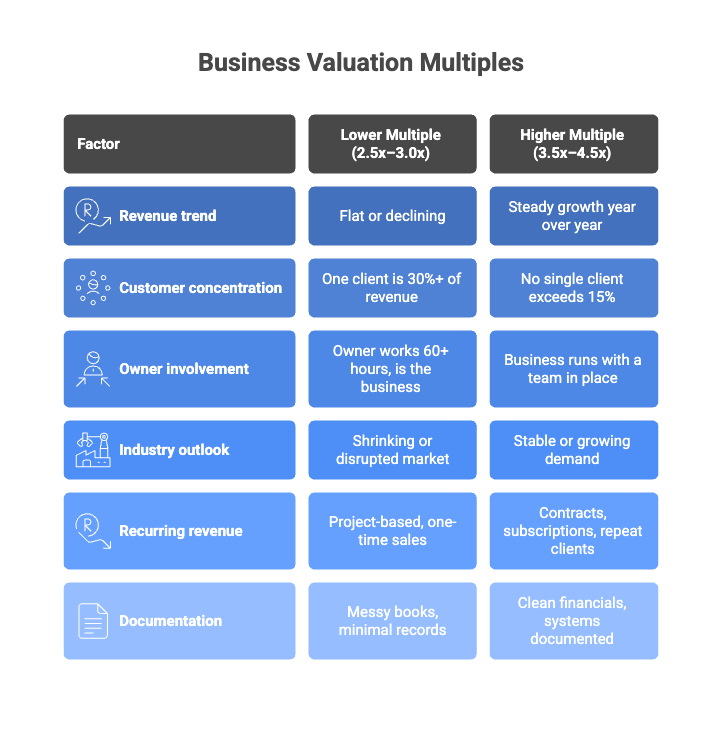
Busines Valuation Multiples
Example: A San Diego HVAC company with $750,000 in SDE, a diversified customer base, two strong managers, and five years of steady growth might command a 3.5x to 4.0x multiple. That puts the valuation between $2.6 million and $3.0 million.
The same SDE from a company where the owner personally handles every major client relationship and revenue has been flat? That multiple drops to 2.5x or lower, bringing the valuation down to $1.8 million or less. Same earnings, very different outcomes.
The Five Factors That Drive Your Valuation Up or Down
1. Owner Dependency
This is the single biggest value killer in small business sales. If you are the business — if clients call your cell phone, if you approve every decision, if walking away for two weeks would cause problems — buyers see risk, not opportunity.
Businesses that operate independently of the owner are worth significantly more. The question every buyer asks is simple: What happens to this business the day after you leave?
Start building that answer now, even if you are years away from selling.
2. Customer Concentration
When one customer represents 20% or more of your revenue, the buyer is not just acquiring a business. They are placing a bet on that single relationship surviving the transition. Most experienced buyers will either walk away from that deal or demand a steep discount.
Diversification takes time to build. If your revenue is concentrated, start broadening your customer base today. Every new client you add is directly increasing the sale price of your business.
3. Financial Documentation
Buyers make decisions based on what they can verify. Three years of clean profit and loss statements, balance sheets, and tax returns are the foundation of any serious deal. If your books are a mess, you will either get a lower offer or no offer at all.
The most common mistake: mixing personal and business expenses without clear documentation. It may save you on taxes in the short term, but it costs you at the negotiating table.
4. Revenue Trends
A business with five years of steady, upward revenue tells a story that buyers want to invest in. A business with volatile or declining revenue forces the buyer to figure out why, and that uncertainty always drives the price down.
If your revenue has dipped, have a clear explanation. A temporary dip caused by a known, resolved issue is very different from a structural decline in your industry.
5. Transferability
Can a new owner step in and operate this business successfully? That question covers everything from documented processes and trained employees to transferable contracts and vendor relationships.
Businesses where the systems live in the owner's head are worth less. Businesses where the systems live in written procedures, trained teams, and organized files are worth more. It is that simple.

Three Things You Can Do Right Now to Increase Your Business Value
You do not need to wait until you are ready to sell to start building value. These three actions pay dividends whether you sell in one year or five:
Get your financials in order. Hire a bookkeeper or accountant if you do not have one. Separate personal and business expenses completely. Build three years of clean, consistent records. This single step can add tens or even hundreds of thousands of dollars to your sale price.
Reduce your role in day-to-day operations. Start delegating. Hire or develop a manager who can run things when you are not there. Every responsibility you hand off makes the business more attractive and more valuable to a buyer.
Document everything. Standard operating procedures, vendor contacts, client history, employee roles and responsibilities. The more a buyer can see how the business runs without asking you, the more confident they will be, and the more they will pay.

What Happens After You Know the Number?
Understanding your business's value is the starting point, not the finish line. Once you have a realistic valuation, you can make informed decisions about timing, deal structure, and what kind of buyer is the right fit.
Some sellers find out their business is worth more than they expected. Others discover there is a gap between what they need for retirement and what the market will pay. Both are valuable insights. The worst outcome is going to market with unrealistic expectations, wasting months, and ultimately accepting less than you could have gotten with proper preparation.
If you are a business owner in San Diego thinking about retirement in the next few years, the smartest move is to get a clear-eyed assessment of where you stand today. That gives you time to close any gaps and sell from a position of strength.

Ready to Find Out What Your Business Is Worth?
At Coastal Business Acquisitions, we help San Diego business owners understand the true value of what they have built. Our introductory call is straightforward: we listen, we ask the right questions, and we give you an honest assessment.
No pressure. No jargon. Just clarity.
Schedule Your Free Introductory Call →
Coastal Business Acquisitions specializes in helping San Diego business owners navigate successful business transitions. Whether you are ready to sell today or planning for the future, we are here to help.