
Should I Sell My Business to a Direct Buyer or Use a Broker? A San Diego Owner's Guide
What to Know Before You Decide How to Sell Your Business

You have decided to sell your business. Now comes the next question: how?
Most business owners assume the answer is to hire a broker. It is the path they have heard about, the one their accountant or attorney might suggest first. And for some sellers, it is the right choice.
But it is not the only choice. A growing number of business owners in San Diego and across Southern California are selling directly to individual buyers — operators who purchase and run the business themselves, without brokers, commissions, or public listings involved.
Both paths can lead to a successful sale. The difference is in how much you pay, how much control you keep, how long it takes, and how confidential the process stays.
Here is an honest comparison so you can decide which path fits your situation.
How a Traditional Business Broker Works
A business broker acts as an intermediary between you and potential buyers. They list your business for sale, market it to their network and online marketplaces, screen interested buyers, facilitate negotiations, and help move the deal toward closing.
What you get with a broker:
Access to a wider pool of potential buyers is the primary advantage. A good broker has a network of qualified buyers actively looking for businesses. They handle the marketing, the initial screening, and much of the back-and-forth negotiation so you can stay focused on running your business.
Brokers also bring transaction experience. If you have never sold a business before, a broker can guide you through the process, help you set a realistic asking price, and manage the timeline.
What it costs:
Broker commissions typically range from 8% to 12% of the final sale price. On a $2 million deal, that is $160,000 to $240,000. Some brokers also charge upfront fees for valuation, marketing, or listing services on top of the commission.
That commission comes directly out of your proceeds. The price the buyer pays is not what you take home.
What to watch for:
Not all brokers are equal. The industry is largely unregulated, and the quality of service varies dramatically. Some brokers will take on your listing, post it on a marketplace, and wait for inbound interest without doing much active outreach. Others will invest significant time and effort into finding the right buyer.
The average time to sell a business through a broker is 6 to 12 months. Some deals take longer. During that time, your business is listed — sometimes on public marketplaces — which introduces confidentiality risk. Even with blind profiles, a motivated competitor or curious employee can sometimes piece together which business is for sale based on the industry, location, and financial details in the listing.
There is also an alignment issue worth understanding. A broker earns their commission only when a deal closes. That creates an incentive to get a deal done, which is generally good — but it can also mean pressure to accept an offer that may not be the best one for you, simply because it is on the table.
How Selling to a Direct Buyer Works
A direct buyer is exactly what it sounds like: someone who approaches you (or whom you approach) to purchase your business without a broker in the middle. This buyer is typically an individual operator, a small investment group, or a company looking to acquire businesses in your industry.
What you get with a direct buyer:
The most immediate benefit is that you keep the commission. There is no 8% to 12% fee because there is no intermediary. The offer price is the price you receive.
Direct buyers also tend to move faster. Because there is no listing period, no marketing phase, and no waiting for inbound interest, the process from first conversation to offer can happen in weeks rather than months. A serious direct buyer who has already secured financing can often present an offer within one to two weeks of reviewing your financials.
Confidentiality is significantly stronger in a direct sale. Your business is never listed publicly. There is no blind profile on a marketplace. The only people who know about the sale are you, the buyer, and your respective advisors. For business owners who are deeply concerned about employees, customers, or competitors finding out, this is often the deciding factor.
Finally, when you sell to an individual operator — someone who plans to run the business personally — the conversation tends to be more personal and more aligned with your values. An operator-buyer is investing their own career into your company. They care about the team, the customers, and the culture because those things directly affect their success. That is a very different dynamic than selling to a financial buyer who is assembling a portfolio.
What to watch for:
A direct buyer is a single buyer. You are not running a competitive process with multiple offers, which means you do not have the benefit of market tension driving the price up. The offer you receive needs to stand on its own merits.
This makes it critical that you understand your business's true value before entering any conversation with a direct buyer. If you do not know what your Seller's Discretionary Earnings are, what multiple your industry commands, and what factors are strengthening or weakening your valuation, you are negotiating blind. Whether you work with a broker or a direct buyer, getting a credible valuation is step one.
It is also worth noting that not every direct buyer is legitimate or qualified. Before sharing any financial information, make sure the buyer has signed a Non-Disclosure Agreement and can demonstrate proof of funds or financing pre-qualification. A serious buyer will do both without hesitation.
Side-by-Side Comparison
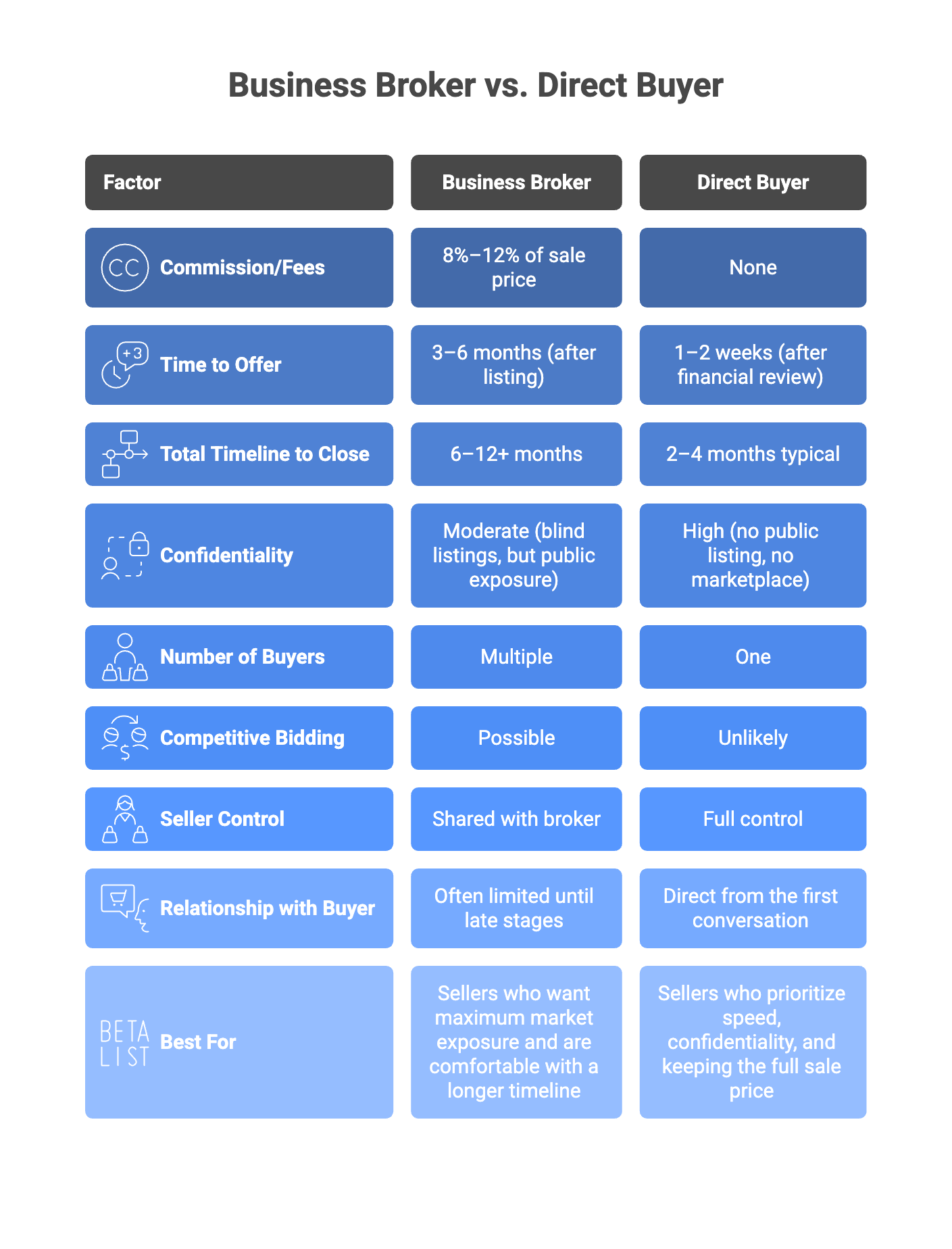
When a Broker Makes More Sense
A broker is often the better choice when your business is in a highly competitive industry where multiple buyers might bid against each other, when you genuinely do not have time to be involved in the sale process at all, or when your business is large enough (typically above $5 million in revenue) that the deal complexity benefits from an intermediary managing multiple parties.
If you have a business that is likely to attract several serious offers and the competitive tension between those offers could push the sale price significantly higher, the broker's commission may pay for itself.
When a Direct Buyer Makes More Sense
A direct buyer is often the better choice when confidentiality is your top priority, when you want to avoid paying $100,000 or more in broker commissions, when you value speed and simplicity over a drawn-out process, or when it matters to you that the person buying your business is someone who will operate it personally and take care of your team.
For many San Diego business owners approaching retirement, the direct buyer path checks every box: it is faster, it is private, it costs nothing, and it puts you face-to-face with the person who will carry your business forward.
Questions to Ask Any Buyer — Broker or Direct
Regardless of which path you choose, ask these questions before committing to anything:
How will you value my business, and what methodology do you use? A credible buyer or broker should be able to explain their valuation process clearly. If the answer is vague, that is a red flag.
How do you protect confidentiality during the process? Ask for specifics. NDAs, blind profiles, controlled information flow, and off-site meetings are all standard practices. If someone cannot explain their confidentiality process in detail, they do not have one.
What is your timeline from first conversation to closing? This sets expectations and helps you plan. Be cautious of anyone who promises an unrealistically fast close without having reviewed your financials.
What happens to my employees after the sale? This question reveals the buyer's intent. An operator who plans to run the business will have a thoughtful answer. A financial buyer who plans to cut costs and resell may not.
Can you provide proof of funds or financing pre-qualification? Do not share sensitive financial information with anyone who cannot demonstrate they have the means to close a deal.
The Bottom Line
There is no universally right answer. The best path depends on your priorities — whether that is maximizing the sale price through competitive bidding, minimizing fees, protecting confidentiality, or finding a buyer who will honor what you built.
What matters most is that you make the decision with clear information, not assumptions. Too many business owners default to hiring a broker because it is the only option they know about. Now you know there is another path — and for many sellers, it is the better one.
Ready to Explore Your Options?
At Coastal Business Acquisitions, we work with owners across San Diego and Southern California on valuation, exit planning, and the sale of their
business. Whatever path makes sense for you, the first step is the same: understanding what your business is worth and what your options actually are.
If you are curious about where you stand, we are happy to talk. Every conversation is confidential. There is no cost and no obligation.
Coastal Business Acquisitions is a San Diego based M&A advisory firm. We help owners of established, privately held companies plan and complete a successful exit, with care, discretion, and long term commitment.